
Liverpool Regeneration Schemes Take Major Shape
Liverpool regeneration schemes totalling £7 billion are set to physically reshape the Merseyside city region in 2026. From the banks of the Mersey to the cinematic ambition of Edge Lane, Liverpool is shedding its industrial skin in favour of a dynamic, mixed-use future.
For decades, developers and local authorities have spoken of potential; however, 2026 is the year that rhetoric transforms into concrete reality. The regeneration strategy is vast, encompassing not just the city centre, but the northern waterfront, surrounding town centres, and the Wirral peninsula. The overarching goal is clear. Specifically, developers will transform underused sites into thriving hubs for housing, employment, and leisure.
Liverpool Regeneration Schemes: Northern Waterfront
 Perhaps the most visually striking alteration to the cityscape is taking place along the northern waterfront. This area, historically defined by warehousing and maritime logistics, is currently the stage for one of the city’s most ambitious private residential ventures.
The King Edward Triangle
The £1 billion King Edward Triangle scheme will dramatically alter the skyline. Spearheaded by KEIE – part of the TJ Morris group – in partnership with Beetham, this project is not merely about housing; it is about creating a vertical neighbourhood. The masterplan envisions a cluster of high-rise structures housing nearly 3,000 apartments.
Beyond residential units, the proposal injects a dose of luxury into the docklands, including plans for a five-star hotel and a potential new events arena. Developers submitted plans for a tower in 2025, and Liverpool City Council approved land sales. Following this, the team expects to make detailed planning submissions during 2026. Once the project secures the green light, a phased delivery programme will commence, stretching into the early 2030s.
Central Docks and the Green Lung
Simultaneously, Peel is advancing with the Central Docks neighbourhood, the jewel in the crown of the wider Liverpool Waters masterplan. Covering 26 acres, this district is set to deliver over 2,000 homes. However, the standout feature here is the commitment to the public realm.
Construction initiated in late 2025 focuses on enabling works and the creation of Central Park. Spanning five acres, this will become one of the largest new green spaces within the inner city, addressing a long-standing need for accessible parkland. Chancellor Rachel Reeves announced £55m in government funding to bolster the project. Therefore, completion of the park and infrastructure is scheduled for 2028.
The ‘Hollywood of the North’
Turning attention eastward, the narrative shifts from residential living to cultural production. The iconic Littlewoods building on Edge Lane, a Grade II-listed structure that has sat dormant for too long, is finally seeing movement.
Following extensive site clearance after the devastating fire of 2018, Capital&Centric is driving a £70m restoration project. The vision is to anchor Liverpool’s booming film and TV sector with a permanent home, featuring two massive 20,000 sq ft studio stages. While preparatory works are active, the developer is currently engaged in crucial funding discussions with the central government. If these negotiations succeed in 2026, construction will begin in earnest. Crucially, this secures Liverpool’s status as a premier production hub later in the decade.
Wirral Waters Joins Liverpool Regeneration Schemes
Regeneration is by no means confined to the Liverpool side of the river. At Wirral Waters, the transformation is already tangible. The Miller’s Quay development has proven the appetite for waterside living, with its 500 apartments reaching full occupancy almost immediately upon completion.
Looking ahead, Peel Waters aims to construct approximately 850 homes in total, including an innovative extra-care village and supporting amenities. With 30 homes already finished at Redbridge Quay and further phases planned for the north docks, the second half of the 2020s will see the Wirral waterfront evolve into a fully matured residential district.
Revitalising Communities and Town Centres
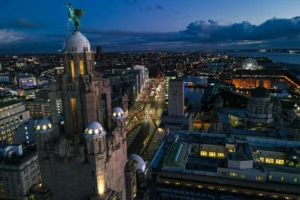 Beyond the headline-grabbing skyscrapers, significant work is underway to revitalise existing communities through thoughtful urban planning.
- Bootle Strand: In Sefton, the local council is taking a hands-on approach. Sefton Council acquired the struggling Bootle Strand shopping centre in 2019. Consequently, they are demolishing sections to pivot away from a pure retail model. Throughout 2026, structural work will continue to replace empty shops with housing, health services, and civic amenities, breathing new life into the town centre.
- Further south, the 1984 International Garden Festival site enters a new chapter. Liverpool City Council appointed Urban Splash and Igloo Regeneration to deliver 440 homes. The proposal is notably inclusive, featuring 110 affordable homes and 80 extra-care units set within a landscaped riverside environment. A planning application is anticipated late in 2026, with spades expected in the ground by 2027.
A £5B Connectivity Vision
Finally, binding these disparate projects together is a grand strategic vision for transport. Liverpool City Region Mayor Steve Rotheram has outlined a £5B plan to revolutionise connectivity between Liverpool Central Station and Lime Street.
The proposal involves regenerating 86 acres between these two key hubs and potentially creating a new underground link. While currently in the strategic phase, 2026 will be crucial for feasibility studies and design work. If realised, these high-density Liverpool regeneration schemes would fundamentally alter the flow of people through the city.